

If you’re comparing rss vs atom differences, you’re likely trying to decide which feed format best fits your platform, application, or content distribution strategy. With so many technical opinions online, it can be difficult to separate practical guidance from outdated or surface-level explanations.
This article is designed to give you a clear, side‑by‑side understanding of how RSS and Atom differ in structure, flexibility, extensibility, and real‑world implementation. We’ll break down how each format handles metadata, content updates, validation standards, and compatibility with modern feed-based systems—so you can make an informed technical decision.
Our insights are grounded in hands-on experience analyzing feed-based network protocols, digital infrastructure strategies, and workflow optimization practices. Rather than repeating generic definitions, we focus on how these formats perform in production environments and what their differences mean for developers, publishers, and system architects.
By the end, you’ll know exactly which format aligns with your goals—and why.
Choosing the Right Syndication Protocol for Your Content
I once picked RSS by default and paid for it later. Our feed broke in a reader because I ignored rss vs atom differences. RSS (Really Simple Syndication) uses looser specifications, while Atom enforces stricter XML standards. That rigidity improves consistency, especially for metadata like timestamps and unique IDs. Some argue RSS is “good enough” for blogs, and they’re not wrong. Simplicity speeds deployment. But if you need extensibility—custom namespaces, precise content typing—Atom wins. PRO TIP: validate feeds before launch. • CAPS • • Think of it like choosing Blu-ray over DVD.
RSS (Really Simple Syndication): The Established Standard
Really Simple Syndication (RSS) began in 1999 at Netscape as a way to distribute website updates automatically. Early versions (0.9x) evolved quickly, with RSS 1.0 introducing RDF-based structure and RSS 2.0 (released in 2002) becoming the most widely adopted format. According to W3Techs, millions of websites still expose RSS feeds today, underscoring its durability as a publishing standard.
At its core, RSS is structured in XML (Extensible Markup Language, a rules-based markup format for data exchange). The hierarchy is straightforward:
<rss>: The root element defining the feed version<channel>: Metadata about the feed itself<item>: Individual content entries
Essential tags inside <item> include:
<title>: Headline of the entry<link>: URL to the full content<description>: Summary or excerpt<pubDate>: Publication date (often inconsistently formatted)<guid>: Unique identifier for deduplication
Pros:
- Broad legacy support across platforms
- Simple, human-readable structure
Cons:
- Ambiguity in specifications
- Less strict date and content validation
Debates about rss vs atom differences often highlight Atom’s stricter standardization. Still, RSS 2.0’s staying power proves that simplicity (like VHS beating Betamax) sometimes wins through adoption alone.
Atom: The Modern, Standardized Alternative
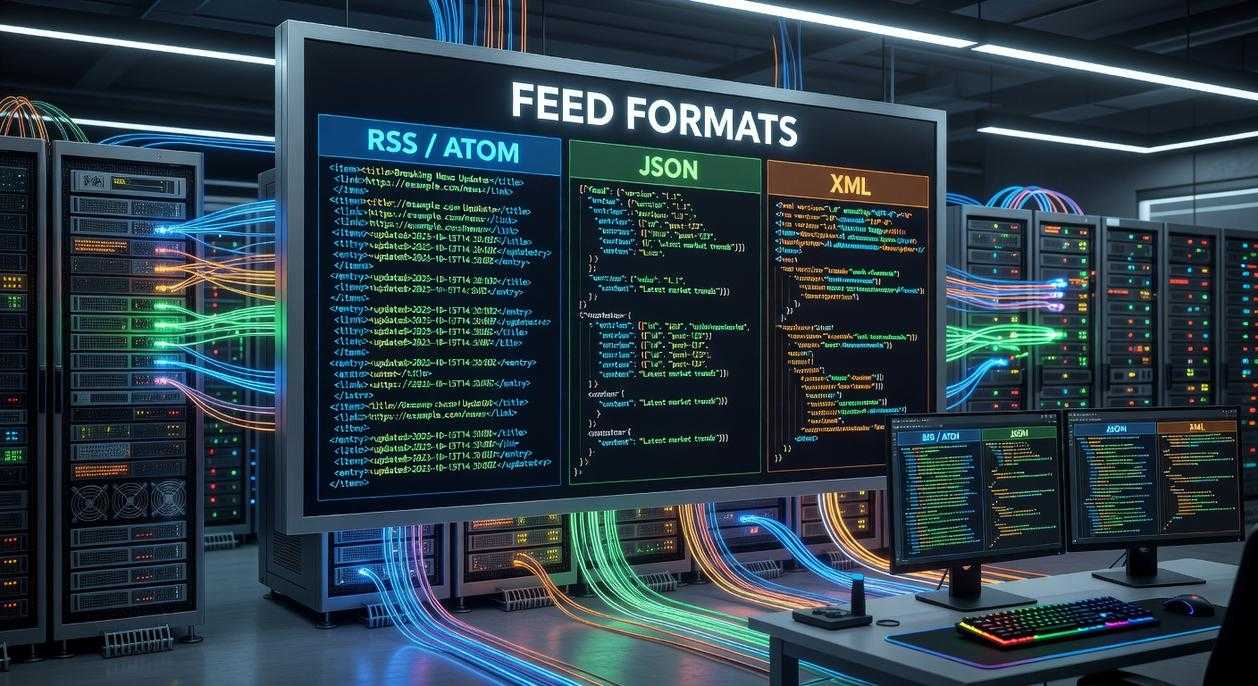
Atom was created to fix the gray areas left by RSS. In the early 2000s, developers grew frustrated with inconsistent implementations and vague specifications. So Atom emerged as a cleaner, standardized solution—formally published as an IETF standard under RFC 4287. In other words, it wasn’t just “another format,” it was a rules-first reset.
At its core, Atom uses a logical XML structure built around <feed> (the container) and <entry> (individual posts). The naming is intuitive, which reduces guesswork for developers (and fewer late-night debugging sessions).
Key elements make this clarity practical:
<title>defines the feed or entry name.<link rel='alternate'>clearly identifies the human-readable URL.<summary>separates excerpts from full content.<content>holds the complete payload.<updated>uses a strict ISO 8601 timestamp format.<id>provides a globally unique identifier.
Compared to rss vs atom differences, Atom removes ambiguity around dates and content handling.
That said, some argue RSS’s older ecosystem means broader legacy support. True—but most modern systems handle Atom seamlessly.
If you’re building or upgrading a feed today, choose Atom for its precision and future-proofing. It pairs especially well with systems built around understanding publish subscribe architecture in modern networks. Clear standards now prevent messy migrations later (pro tip: always validate your feed against the RFC schema before launch).
Technical Breakdown: A Direct Feature Comparison
When people debate feed standards, they often focus on history or popularity. I prefer looking at structure. Because once you examine the mechanics, the practical advantages become obvious.
Data & Time Stamps
First, let’s talk dates. RSS uses the RFC 822 format for <pubDate>, which is fairly permissive. In theory, that flexibility is helpful. In practice, it invites inconsistency. Different servers format dates slightly differently, and parsers have to guess what was meant (which is never a comforting sentence in software).
Atom, by contrast, requires RFC 3339 for <updated>. That format is strict, machine-readable, and unambiguous. There’s no room for creative interpretation. As a result, parsing errors drop significantly because the structure is predictable (and predictable is beautiful in infrastructure).
Content Type Handling
Now consider content modeling. RSS relies heavily on <description>, which can contain plain text or escaped HTML. That dual-purpose approach works, but it muddies intent. Is this a summary? Full content? HTML snippet?
Atom separates concerns cleanly. <summary> is plain text. <content> is explicitly typed—HTML, XHTML, or another declared format. This clarity removes guesswork. In my opinion, this is one of Atom’s most underrated strengths: explicit typing prevents ambiguity before it even starts.
Unique Identifiers
RSS includes <guid>, but here’s the catch—it doesn’t have to be permanent. Sometimes it’s just a URL. Sometimes it isn’t. That variability can cause confusion if entries shift or URLs change.
Atom mandates a universally unique <id> for every entry. It must remain stable over time. That requirement dramatically reduces duplication and sync errors. If you care about long-term data integrity, this matters more than people admit.
Extensibility & Namespaces
Both formats support XML namespaces for extensions. However, Atom’s overall schema feels cleaner and more intentionally designed for extensibility. Adding new metadata is less awkward and better standardized. To me, that signals forward-thinking architecture.
Link Specificity
Finally, linking. RSS provides a single <link> per item, typically pointing to the primary URL. Atom’s <link> element includes a rel attribute—such as rel='self' or rel='alternate'—which clarifies context. That extra specificity makes integrations smarter and more flexible.
When people compare rss vs atom differences, they often treat it as a legacy battle. I see it differently. RSS works. Atom is simply more disciplined. And in structured data systems, discipline usually wins.
Which Feed Format Should You Implement Today?
Choosing a feed format isn’t just technical housekeeping—it shapes how your content moves across the web.
For Maximum Compatibility, RSS 2.0 remains the safe bet. If you must support older aggregators or pre-2010 enterprise tools, RSS ensures broad readability. It’s simple, forgiving, and widely recognized (like the USB-A of feeds).
For Technical Superiority & Future-Proofing, Atom is the stronger foundation. Its strict specification (meaning tighter rules for structure and validation), better namespace handling, and consistent date formats reduce parsing errors and improve API integrations. When teams compare rss vs atom differences, they often overlook Atom’s clearer extensibility model—critical for modern microservices and automation pipelines.
The Hybrid Approach is common: publish both RSS and Atom, then reference each in your HTML header and at /feed.
Quick Decision Checklist:
- Need legacy compatibility? Use RSS.
- Building a new API or app? Use Atom.
- Want maximum reach? Offer both (pro tip: monitor subscriber behavior before retiring either).
Mastering RSS and Atom for Smarter Feed Delivery
You came here to clearly understand the rss vs atom differences and how each format impacts your feed delivery, compatibility, and workflow efficiency. Now you have a practical breakdown of how they structure data, handle metadata, and integrate with modern systems—so you can choose the right format with confidence.
If inconsistent feed behavior, limited metadata control, or integration headaches have been slowing you down, the right protocol choice solves that. Selecting the appropriate standard ensures cleaner syndication, better interoperability, and fewer technical bottlenecks across your infrastructure.
Don’t let outdated feed decisions limit your scalability. Audit your current feed setup, align it with your distribution goals, and optimize for long-term flexibility. If you want clearer implementation strategies, deeper protocol insights, and proven workflow optimization techniques trusted by thousands of tech professionals, explore more expert breakdowns now and start building a smarter, more resilient feed system today.